
Historic 1923 Lang House Kitchen Remodel | San Diego Spanish Revival Home Renovation by Murray Lampert
Murray Lampert remodeled the HRB-designated 1923 Lang House at 3696 Albatross Street in San Diego — a Spanish Revival masterpiece by Master Architect Henry J. Lang. See how we preserved historic character while expanding and modernizing the kitchen.
Last updated: November 2, 2026
Murray Lampert had the honor of working on the historic Kate M. Dillon and Florence A. Maddock/Henry J. Lang House, located at 3696 Albatross Street in San Diego’s Uptown community (Council District 3). Built in 1923 and designated by San Diego’s Historical Resources Board (HRB) under Report No. HRB-08-062, this Spanish Eclectic/Revival residence is a recognized work of Master Architect Henry J. Lang — and one of the most architecturally distinctive homes in the Cleveland Heights neighborhood.
About the House
The single-story frame and stucco house is a refined example of Spanish Eclectic/Revival architecture, constructed in 1923 for Florence A. Maddock and Kate M. Dillon.
The east façade is anchored by a large square tower with a hipped, clay-tile roof, exposed rafter tails, and three arched louvered vents. An arched entry alcove is set beneath two cantilevered tiled overhangs. The main body of the house lies under a flat roof with parapets stepped at the corners — a hallmark of Mission and Spanish Revival composition. The north façade features a stuccoed chimney with a recessed niche and decorative cap.
Window types vary thoughtfully across the home: wood true divided light casement windows with arched horizontal muntins flank the tower on the east, while the south and rear façades offer a deliberate mix of tri-part and double-hung windows.
HRB Designation: The property was reviewed and recommended for designation under:
- Criterion C — as a good example of Spanish Eclectic/Revival architecture with a high degree of integrity and distinctive characteristics
- Criterion D — as a notable work by Master Architect Henry J. Lang
Henry J. Lang (1859–unknown) was born in Germany and built his reputation in San Diego primarily through speculative homes and individual commissions. Other HRB-designated Lang works include homes at 1787 Fort Stockton Drive (HRB Site #776), 1530 29th Street (HRB Site #620), and 3703 Albatross Street (HRB Site #732) — just steps from this property.
Read the full HRB staff report: HRB Report No. HRB-08-062 — 3696 Albatross Street (PDF)
About the Project
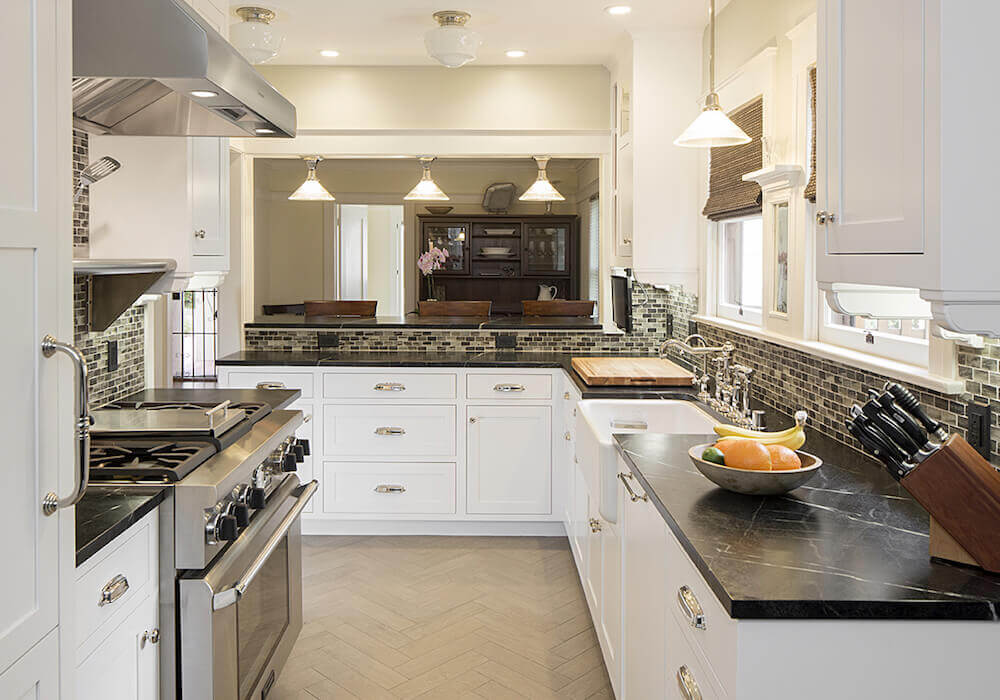
Our scope was to remodel a very small galley kitchen and expand it by reclaiming adjacent space — without altering the home’s protected exterior.
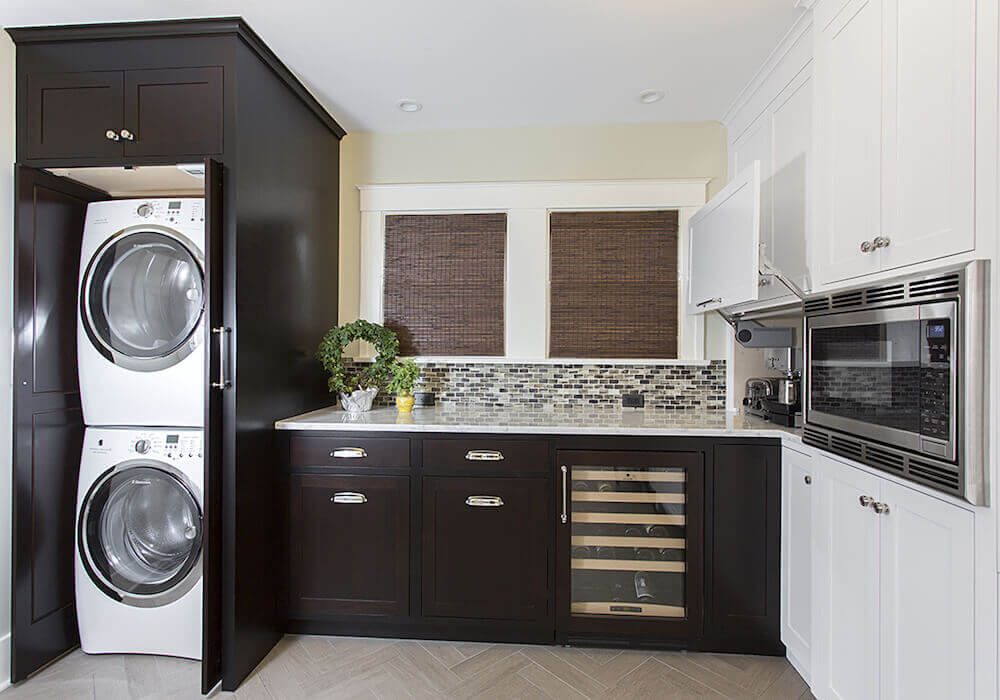
We removed two load-bearing walls: one dividing the kitchen from the laundry room, and one dividing the kitchen from the dining room. Opening those walls transformed a cramped, compartmentalized work space into a flowing, light-filled kitchen and utility area.
To protect the historic exterior envelope, we retained the existing double-sash wood windows and sourced new windows that precisely match the original sight lines and finish — consistent with the Secretary of the Interior’s Standards for Rehabilitation, which govern any work on a San Diego HRB-designated property.
Project features include:
- Custom-built cabinets with flush inset doors
- Soapstone counters
- Tumbled glass tile backsplash
- Tile floor in a herringbone pattern
- Farmhouse sink
- Stainless steel appliances
- Built-in washer/dryer area
- Wine chiller
The Mills Act: Property Tax Relief for San Diego’s Historic Homeowners
Because the Lang House carries an HRB designation, its owners are eligible for a Mills Act Agreement — one of the most valuable financial incentives available to owners of San Diego historic properties.
What Is the Mills Act?
The Mills Act (California Government Code §§ 50280–50290) is a voluntary preservation program that allows cities to enter into 10-year contracts with owners of locally designated historic properties. In exchange for a binding commitment to maintain and rehabilitate the property according to adopted preservation standards, owners receive a significant reduction in property taxes.
Rather than being assessed at market value under Proposition 13, Mills Act properties are assessed using a capitalized income value formula — typically resulting in tax savings of 40 to 60 percent compared to standard assessments.
How It Works in San Diego
The City of San Diego administers its own Mills Act Program through the City Planning Department. Key terms:
- Contract term: 10 years, automatically renewed each year (rolling) unless either party provides written notice of non-renewal
- Eligible properties: Must be on the San Diego Historic Resources Register — which includes HRB-designated properties like the Lang House
- Owner obligations: Maintain the property in good condition and undertake any approved rehabilitation work using the Secretary of the Interior’s Standards
- Tax benefit: Calculated annually based on gross income potential of the property divided by a capitalization rate — typically far below the Proposition 13 assessed value
Is the Mills Act Worth It?
For owners of designated San Diego homes — particularly single-family residences in Uptown, Mission Hills, North Park, and South Park where assessed values have risen sharply — the savings can exceed tens of thousands of dollars over the life of the contract.
The HRB staff report for the Lang House specifically noted that designation would make “the Mills Act, the Historical Building Code, and related regulatory flexibility available” to the property owners. The Historical Building Code provides additional flexibility for code-compliant renovation work that respects the historic fabric of the structure.
If you own a historically designated home in San Diego and are considering a renovation, Murray Lampert can help you navigate Mills Act requirements and ensure your project meets the Secretary of the Interior’s Standards. Contact us to discuss your project.
Remodeling a Designated Historic Home in San Diego
Working within San Diego’s historic preservation framework requires experience, patience, and a genuine respect for architectural history. Murray Lampert’s design-build process is well-suited to historic renovation: our in-house architectural designers and project managers coordinate from early design through final inspection, ensuring that improvements enhance livability without compromising the character that earned the designation in the first place.
For the Lang House, that meant a kitchen that functions like a 21st-century workspace while remaining unmistakably part of a 1923 Spanish Revival home.
If you own a historic home in San Diego and are considering a remodel, we’d love to hear about it. You can also explore more of our kitchen remodeling work or learn more about Murray Lampert’s history and approach.